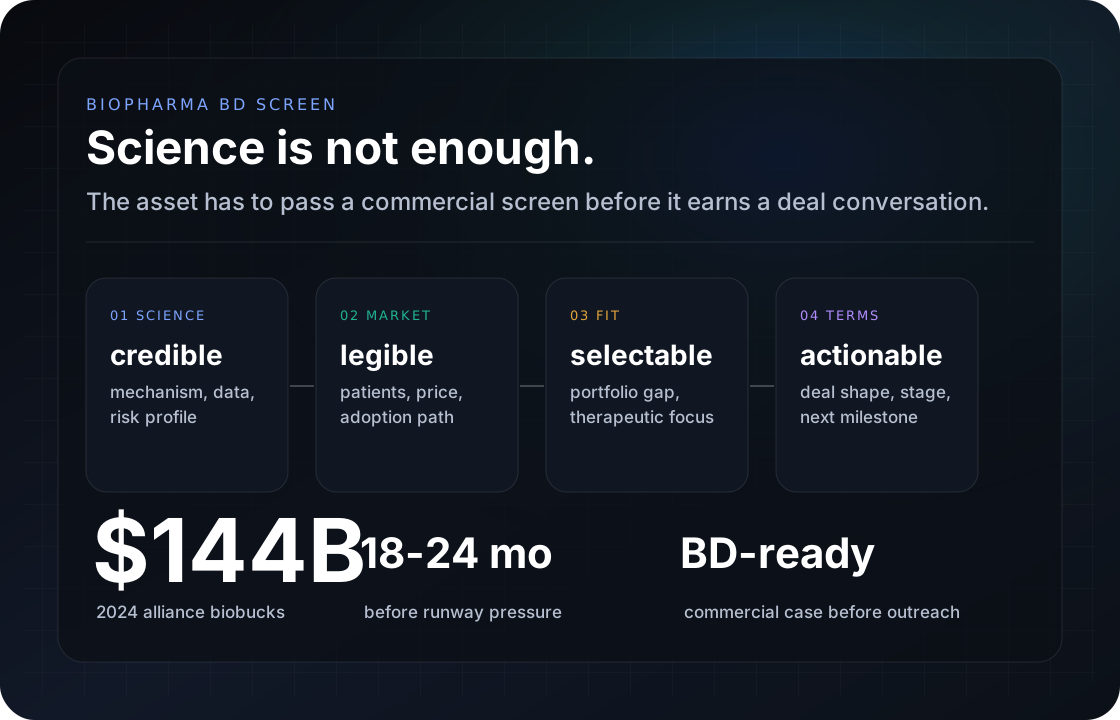
Pharma companies executed 220 alliances worth $144 billion in potential deal value in 2024 alone. The partnership capital exists. Small biotechs lose access when the commercial case is not ready: patient population, portfolio fit, competitive difference, and deal shape. Scientific credibility gets a biotech noticed. Commercial legibility gets it seriously evaluated.

If pharma outreach matters this year, fix the commercial case before the next BD push.
Request the Marketing Strategy ReviewWhich pharma portfolios should care and why.
What BD needs beyond the scientific story.
Who to approach first, with what argument, and when.
- Pharma alliances reached $144 billion in biobucks in 2024, the highest value in a decade (EY/DCAT).
- Total biopharma deal value peaked at $191 billion in 2024 (McKinsey).
- 39% of small biotechs have less than one year of cash runway (EY Beyond Borders, 2025).
- External innovation outperformers achieve 3.4 to 8.2x greater returns on sourced assets (McKinsey).
- The screening problem: pharma BD teams evaluate hundreds of assets annually and filter on commercial clarity first.
The market is active. The positioning is not.
The biotech partnership market is not closed. Large pharmaceutical companies are actively seeking assets to license, co-develop, and acquire. Patent expiry pressures, pipeline gaps, and the strategic shift toward external innovation have made pharma companies more dependent on biotech partnerships than at any point in the past decade.
McKinsey's analysis of biopharma dealmaking shows that since 2018, more than 70 percent of new molecular entity revenues at large pharmaceutical companies have come from externally sourced products. The innovation pipeline for pharma runs through biotech. The demand for partnerships is real and structural, not cyclical.
McKinsey biopharma dealmaking analysis: McKinsey, Pulse Check: Key Trends Shaping Biopharma Dealmaking in 2025
The declining volume with rising value tells you something important about how the market has changed. Fewer deals at higher individual value means pharma companies are being more selective, committing larger resources to fewer, higher-conviction partnerships. The competition for a slot in a pharma company's partnership portfolio has intensified even as the total capital available has grown.
The cash pressure is real and asymmetric
The financial context for small biotech companies seeking partnerships is structurally difficult. EY's Beyond Borders Biotech research reports that 39% of small biotech companies had less than one year of cash runway in 2025, a figure that has risen from 31% over the preceding four years. More than half of publicly traded biotech firms ended 2024 with less than two years of runway.
EY Beyond Borders Biotech 2025: EY Life Sciences / Biotech Outlook
This creates an asymmetric negotiating changing that pharma business development teams understand well. A biotech company approaching a large pharma partner in the final year of runway is negotiating under visible time pressure. Pharma companies can slow-walk the process, knowing the biotech's options narrow with each passing quarter. The deal structure that results often reflects the biotech's timeline constraint, not the asset's actual value.
The companies that negotiate more favorable partnership terms are those that begin the process 18 to 24 months before their cash position becomes constraining. The commercial positioning and partnership documentation are ready. The asset is not yet fully de-risked, but it is presented with the commercial clarity that earns serious evaluation rather than polite deferral.
What pharma BD teams actually screen on
Pharma business development teams reviewing potential partnership assets are not making primary scientific evaluations. Their scientific teams do that. BD teams are filtering for commercial legibility: can this asset be evaluated quickly against the pharma company's portfolio priorities, and does the biotech team understand the commercial case for their own asset?
The five-part commercial screen that experienced BD teams apply covers the addressable patient population and how it maps to the pharma company's existing therapeutic focus, competitive differentiation from current and pipeline standards of care in terms a market access team can evaluate, the clinical and regulatory risk profile expressed in commercial terms rather than scientific ones, the partnership structure the biotech is proposing and whether it aligns with how the pharma company evaluates licensing economics, and the biotech team's commercial awareness: do they understand what it takes to bring this asset to market, or are they scientists who have not yet engaged the commercial questions?
Most biotech presentations are built by scientific teams to convince scientific audiences. They demonstrate mechanism, efficacy data, and safety profile with rigour. They do not address patient population sizing in the commercial terms that a BD team needs, do not position against competitive alternatives in a way that maps to the pharma company's portfolio strategy, and do not present partnership economics in the structure that large pharma commercial teams work with.
The external innovation outperformer pattern
McKinsey's biopharma research identifies a specific pattern among pharma companies that consistently achieve superior returns on externally sourced assets. These external innovation outperformers achieve 3.4 to 8.2 times greater returns than peers on assets they source, license, or acquire.
The pattern that characterizes outperformers is relevant to biotech positioning strategy. These companies focus on specific therapeutic areas and identify opportunities early in development, before the asset is fully de-risked. They are searching systematically, not waiting for biotechs to bring mature assets to their attention.
For a Bay Area biotech with an early-to-mid stage asset, this means the outperformer pharma companies are actively looking for what you have, earlier than most biotechs expect. The commercial positioning and partnership narrative need to be ready before Phase 2 results, not after. Companies that build the commercial case alongside the clinical program are findable by the pharma companies that move earliest and pay the best terms.
For biotech companies building or refining partnership positioning, the first paid step is the Marketing Strategy Review. It maps the commercial case, the buyer language, and the partnership plan before outreach. The life sciences approach is at sfmarketing.agency/for/life-sciences/.