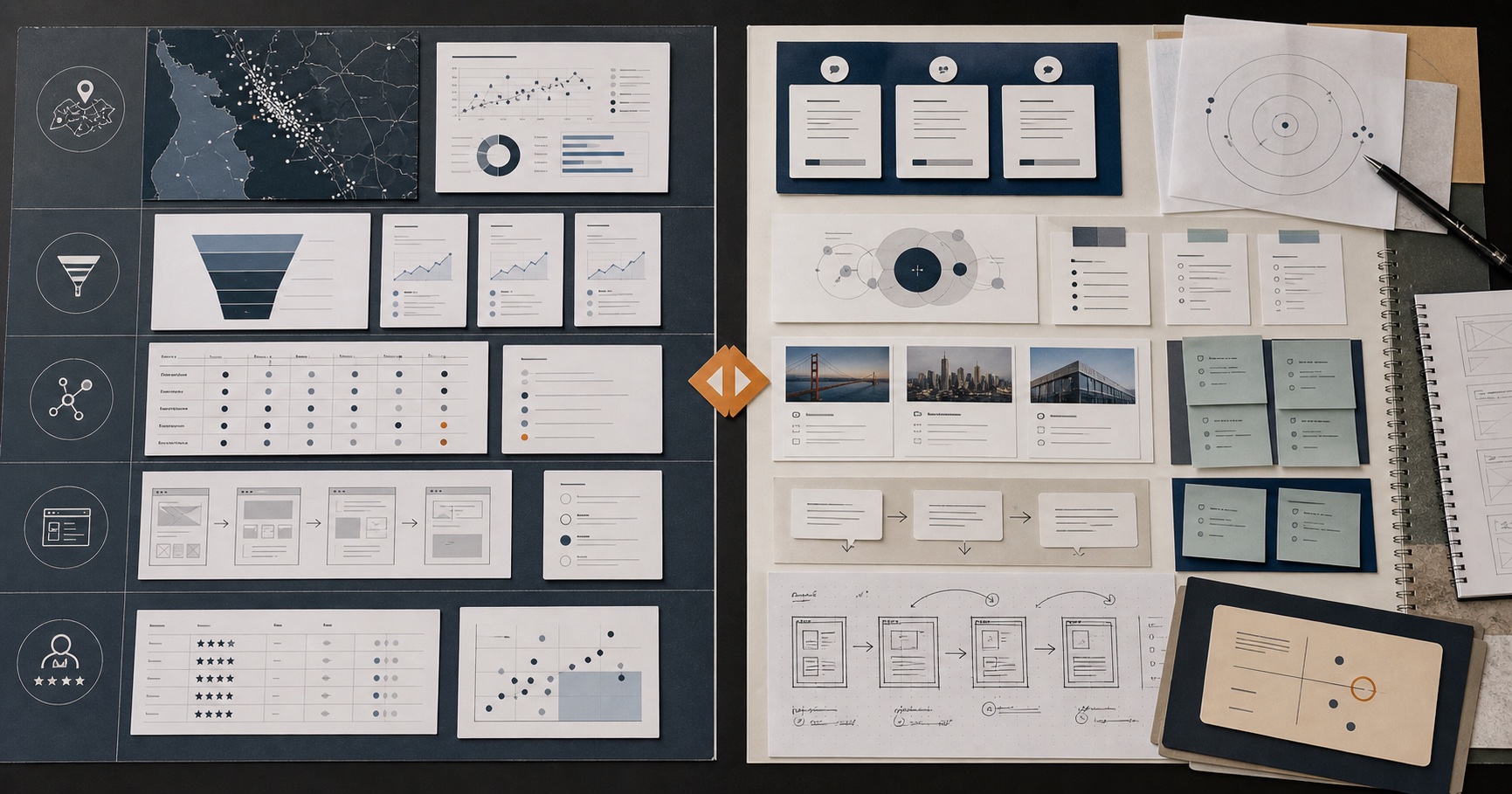
Both are fixed-scope, written-deliverable SFMA gates. The Marketing Strategy Review at $5,000 in 10 days answers what to do. The Positioning Sprint at $7,500 in 14 days answers why this product over the obvious alternatives.
Built for Bay Area B2B founders and VPs of Marketing weighing which SFMA gate to start with. Almquist HBR 2018 maps 40 distinct B2B value elements. Gartner 2024 finds ~70% of the buying journey happens before a rep is involved. Both numbers shape the choice.
Marketing Strategy Review: 20-30 page strategy doc + 90-day plan. Positioning Sprint: positioning system + messaging architecture for 3-5 buyer roles.
Read the FrameworkPick the $5,000 Marketing Strategy Review when the question is what to do or whether the current direction is right. Pick the $7,500 Positioning Sprint when the strategy is settled and the bottleneck is articulating why a buyer should choose this product. Almquist HBR 2018 maps 40 B2B value elements across four tiers. The marketing review decides which tier you should compete on. The sprint writes the language that wins on that tier.
Both produce a written, owned, named-source-backed artifact. The two engagements answer different questions and pair well in sequence.
| Dimension | Marketing Strategy Review | Positioning Sprint |
|---|---|---|
| Price | $5,000 flat | $7,500 flat |
| Timeline | 10 business days | 14 business days |
| Core question | What should we do, and in what order? | Why should a buyer pick this over alternatives? |
| Output | 20-30 page strategy doc + 90-day plan + executive session | Positioning system + messaging architecture for 3-5 buyer roles + executive session |
| Named framework | Krzyzek 2024 pipeline frame, McKinsey 2024 buying committee math | Almquist HBR 2018 B2B value-tier framework (40 elements, 4 tiers) |
| Covers ICP work? | Yes. ICP definition, motion fit, channel sequencing. | Assumes ICP is set. Maps messaging to ICP and buyer roles inside the ICP. |
| Covers attribution? | Yes. Attribution audit and recommendations. | No. Out of scope. |
| Covers messaging architecture? | Topline messaging only. | Yes. Per buyer role, per stage, per value tier. |
| Deliverable lifetime | 2-3 quarters of active reference use | 4-6 quarters of active reference use |
| When to start here | Pipeline is flat, motion is unclear, board has questions, ICP drift suspected. | Strategy settled, motion working, but team can't articulate the why in one sentence. |
Pipeline is flat or unpredictable. The board has started asking questions. The team is shipping but the output doesn't feel like it's compounding. Someone internally has begun to wonder whether the ICP is right, whether the motion is right, or whether the channel mix is right. Multiple plausible reviews, no agreement on which one matters.
This is the Krzyzek 2024 setup. Most B2B service firms in this situation have a pipeline problem, not a marketing problem, and the fix is a written review of the actual root cause. The $5,000 marketing review produces a 20-30 page strategy document that names the problem, ranks the candidate causes, and sequences the next 90 days. That document then tells you whether positioning is the bottleneck or something else is.
The marketing review also wins when the team is mid-hire. Any new VP Marketing or fractional CMO landing without a written strategy spends the first 60 days rewriting whatever the previous operator was doing. Handing the new hire a 20-30 page document on day one shifts that into critique and execution. McKinsey 2024 finds buying committees now average 10 people across 10-plus interactions. Sequencing the right messaging across those interactions starts with strategy, not language.
And it wins when the buyer is unsure whether positioning is even the gap. Buying the sprint for a team that actually has a channel mix problem produces messaging the team can't operationalize. The marketing review is the cheaper way to find out which problem is the real one.
Strategy is settled. ICP is clear. The motion is repeatable. Numbers work at the unit level. What the team can't do is write one sentence that explains why a buyer should choose this product over the obvious alternative. Sales reps describe the product five different ways. The website says one thing. The deck says another. The CEO says a third in podcast interviews.
This is the Almquist HBR 2018 frame. B2B value lives across 40 distinct elements grouped into four tiers: table stakes, functional, ease-of-doing-business, and individual and inspirational. Most companies compete on the functional tier and lose. The differentiators usually sit higher. The Positioning Sprint maps your product onto the value-tier framework and produces a messaging architecture across 3-5 buyer roles.
Gartner 2024 strengthens the case. About 70% of the B2B buying journey is complete before the buyer ever talks to a rep, so the positioning has to do the convincing on the page. HubSpot 2024 finds top B2B sites publish more specific buyer-question answers than competitors. The sprint produces those answers as a written system the team can use for years.
The sprint also wins when a brand identity project is on deck. Doing brand identity without a positioning system underneath produces visuals that don't reinforce a thesis. The sprint at $7,500 should sit before any $20K-$80K brand identity engagement, not after.
Three questions decide it for almost every Bay Area B2B team.
Question 1. If sales lost the next 10 deals, would the post-mortem more often blame the wrong motion, the wrong channels, or the wrong attribution? Or would it more often blame messaging the buyer couldn't repeat?
Question 2. If you handed a new VP Marketing your current positioning document right now, could they defend it to the board in one meeting? Or would they spend a week rewriting it?
Question 3. Has the company changed materially in the last 12 months (new ICP, new motion, new pricing, new round, new exec hire)? If yes, the strategic foundation usually needs rewriting before the language can.
If the post-mortems blame motion, channels, or attribution, the bottleneck is strategy. Start with the $5,000 Marketing Strategy Review. Krzyzek 2024 frames this directly: most B2B firms that suspect a marketing problem actually have a pipeline problem rooted in unwritten strategy. The marketing review surfaces the root cause and produces the 90-day plan.
If the post-mortems blame messaging the buyer can't repeat, the bottleneck is positioning. Start with the $7,500 Positioning Sprint. Almquist HBR 2018 is the foundation: B2B value tiers and elements give you 40 places to compete, and most teams default to the wrong four. The sprint maps the right ones.
If the company has changed materially, run the Marketing Strategy Review first regardless. Positioning written against an old strategy is positioning that lies politely. McKinsey 2024 finds buying committees average 10 people across 10-plus interactions, and the strategy decides which roles those 10 are. The sprint then writes for each role.
Common path for $5M-$30M ARR Bay Area B2B: Marketing Strategy Review first ($5,000, 10 days), Positioning Sprint second ($7,500, 14 days). Total $12,500 across about five weeks. The sprint runs faster as the second engagement because the strategic foundation is already written. HubSpot 2024 finds specificity in buyer-question answers correlates with site-level pipeline performance, and specificity is downstream of having both documents.
distinct B2B elements of value across four tiers. Most companies compete on the functional tier and lose to companies competing on individual and inspirational elements.
Almquist · HBR · 2018
of the B2B buying journey is complete before the buyer ever contacts a vendor. The positioning system has to do the convincing the rep used to do.
Gartner · Future of B2B Sales · 2024
match between B2B vendor self-description and buyer experience. The gap is mostly upstream in positioning and strategy, not in execution craft.
TrustRadius · B2B Buying Disconnect · 2023
Read together, these three numbers describe the spread. 40 value elements means you have to pick which to compete on. 70% pre-vendor research means the page has to win the argument. 38% match rate means most teams describe themselves differently than buyers experience them. Marketing Review decides which tier. Sprint writes the language.
"Of the 40 elements of value in B2B, the ones that drive purchase decisions are rarely the ones vendors emphasize. Functional elements like product quality and price are necessary. Inspirational and individual elements like vision, hope, and reduced anxiety differentiate."Almquist · Cleghorn · Sherer · Harvard Business Review · March 2018
No invented benchmarks. Every line below has a publisher, a year, and a public URL in the citations section.
| Source | Marketing Strategy Review strength | Positioning Sprint strength |
|---|---|---|
| Almquist HBR 2018 · B2B Elements of Value | Marketing Review decides which value tier to compete on at the strategic level. | Sprint maps the product to specific value elements and writes the messaging. |
| Gartner 2024 · Future of B2B Sales | Marketing Review sequences which artifacts have to exist before the rep enters the deal. | Sprint writes the artifacts that win the ~70% pre-vendor journey. |
| McKinsey 2024 · B2B Pulse | Marketing Review maps the 10-person buying committee and channels each role uses. | Sprint writes per-role messaging for the 3-5 most decision-relevant committee seats. |
| HubSpot 2024 · State of Marketing | Marketing Review identifies which buyer questions need answers on the site. | Sprint produces the specific buyer-question answers that top B2B sites use. |
| Krzyzek 2024 · Pipeline Problem | Marketing Review surfaces the root cause when pipeline is flat. Usually upstream of language. | Sprint fixes the language layer once the upstream cause is named. |
| TrustRadius 2023 · B2B Buying Disconnect | Marketing Review identifies where strategy and buyer experience diverge. | Sprint closes the language gap that produces the 62% mismatch. |
| SFMA fixed-scope offers | $5,000 / 10 days / 20-30 page strategy doc + 90-day plan + executive session. | $7,500 / 14 days / positioning system + messaging architecture + executive session. |
Marketing Strategy Review first. $5,000, 10 business days. It covers ICP, motion fit, attribution, channel mix, and a 90-day plan. If the marketing review concludes the actual problem is positioning, the Positioning Sprint at $7,500 is the follow-on, and the strategy doc tells you exactly what positioning has to fix. Running positioning first without the strategic frame produces messaging the team can't operationalize. Krzyzek 2024 calls this the pipeline problem dressed as a marketing problem. The marketing review surfaces the real cause.
The Marketing Strategy Review ($5,000, 10 days) answers what to do. ICP. Motion. Channel sequencing. Attribution. 90-day plan. The Positioning Sprint ($7,500, 14 days) answers why this product over alternatives. Positioning system. Messaging architecture for 3-5 buyer roles. Almquist HBR 2018 frames B2B value as 40 distinct elements across functional, ease-of-business, individual, and inspirational tiers. The sprint maps your product to those tiers. The marketing review decides whether the positioning gap is even the bottleneck.
When the strategy is already settled and the bottleneck is articulation. ICP is clear. Motion is repeatable. Channels are funded. The team can ship. But nobody can explain in one sentence why a buyer should pick this product over the obvious alternative. HubSpot 2024 finds top B2B sites publish more specific buyer-question answers than competitors. The sprint produces those answers for 3-5 buyer roles. If strategy is not settled, the sprint produces messaging the team can't defend, so the marketing review comes first.
Positioning but no strategy is unusual. Usually it means the team has a messaging file the founder wrote, but no 90-day plan, no attribution story, no buyer committee map. That's the Marketing Strategy Review. Strategy but no positioning is more common. The team can defend the math but can't write the why. That's the Positioning Sprint. Gartner 2024 finds ~70% of the B2B buying journey is complete before the buyer ever contacts a vendor, so the positioning has to do the convincing alone. The sprint writes what shows up before any rep.
Common path. Marketing Strategy Review first ($5,000, 10 days), Positioning Sprint second ($7,500, 14 days). Total $12,500 across roughly five weeks. The marketing review tells the sprint what positioning has to do. The sprint writes the system. Bay Area B2B teams at $5M-$30M ARR who run both back-to-back report the second engagement is faster because the strategic foundation is already written. Almquist HBR 2018 underlying frame: you can't pick which of the 40 value elements to lean on without knowing the ICP first.
Different unit of work. The Positioning Sprint produces a positioning system and a messaging architecture: ICP narrative, category definition, value tier mapping per Almquist HBR 2018, buyer role messaging, and proof asset map. No logo work. No color system. No type system. A brand identity project does the visual work and usually costs $20K-$80K. The sprint is upstream. Brand identity should sit on top of positioning, not under it. McKinsey 2024 finds buying committees average 10 people across 10-plus interactions, so the messaging architecture has to cover each role.
That's usually not a positioning problem. HubSpot 2024 finds top B2B sites publish more specific buyer-question answers than competitors. If the positioning is settled and the content is generic, the gap is in the content brief or the publishing cadence, not in the positioning system. The Marketing Strategy Review surfaces this at $5,000 in 10 days and produces a content sequence as part of the 90-day plan. Buying the sprint to fix a content problem is buying the wrong unit.
Both produce written, owned artifacts. The marketing review's 20-30 page strategy document plus 90-day plan typically gets reread by the team for two to three quarters. The Positioning Sprint's positioning system and messaging architecture tend to be referenced for four to six quarters because the value-tier mapping per Almquist HBR 2018 changes less often than tactical strategy. Most clients run the marketing review first, then the sprint, then the Marketing Partnership at $4,500 per month to keep both documents alive.
Ten business days. 20-30 page strategy document. 90-day plan. The marketing review tells you whether the Positioning Sprint is the right next gate or whether the bottleneck sits somewhere else.
Use this in your inquiry
If this matches the decision you need to make, use the contact form and tell us which option you are weighing. The first reply can start with that choice.
Choose the first gate